
Frequently Asked Questions
Credit scoring models are complex and often vary among creditors and for different types of credit. If one factor changes, your score may change — but improvement generally depends on how that factor relates to other factors considered by the model. Only the creditor can explain what might improve your score under the particular model used to evaluate your credit application.
Nevertheless, scoring models generally evaluate the following types of information in your credit report:
- Have you paid your bills on time? Payment history typically is a significant factor. It is likely that your score will be affected negatively if you have paid bills late, had an account referred to collections, or declared bankruptcy, if that history is reflected on your credit report.
- What is your outstanding debt? Many scoring models evaluate the amount of debt you have compared to your credit limits. If the amount you owe is close to your credit limit, that is likely to have a negative effect on your score.
- How long is your credit history? Generally, models consider the length of your credit track record. An insufficient credit history may have an effect on your score, but that can be offset by other factors, such as timely payments and low balances.
- Have you applied for new credit recently? Many scoring models consider whether you have applied for credit recently by looking at “inquiries” on your credit report when you apply for credit. If you have applied for too many new accounts recently, that may negatively affect your score. However, not all inquiries are counted. Inquiries by creditors who are monitoring your account or looking at credit reports to make “prescreened” credit offers are not counted.
- How many and what types of credit accounts do you have? Although it is generally good to have established credit accounts, too many credit card accounts may have a negative effect on your score. In addition, many models consider the type of credit accounts you have. For example, under some scoring models, loans from finance companies may negatively affect your credit score.
Scoring models may be based on more than just information in your credit report. For example, the model may consider information from your credit application as well: your job or occupation, length of employment, or whether you own a home.
To improve your credit score under most models, concentrate on paying your bills on time, paying down outstanding balances, and not taking on new debt. It’s likely to take some time to improve your score significantly.
Below is a list of documents that are required when you apply for a mortgage. However, every situation is unique and you may be required to provide additional documentation. So, if you are asked for more information, be cooperative and provide the information requested as soon as possible. It will help speed up the application process.
Your Property
- Copy of signed sales contract including all riders
- Verification of the deposit you placed on the home
- Names, addresses and telephone numbers of all realtors, builders, insurance agents and attorneys involved
- Copy of Listing Sheet and legal description if available (if the property is a condominium please provide condominium declaration, by-laws and most recent budget)
Your Income
- Copies of your pay-stubs for the most recent 30-day period and year-to-date
- Copies of your W-2 forms for the past two years
- Names and addresses of all employers for the last two years
- Letter explaining any gaps in employment in the past 2 years
- Work visa or green card (copy front & back)
If self-employed or receive commission or bonus, interest/dividends, or rental income:
- Provide full tax returns for the last two years PLUS year-to-date Profit and Loss statement (please provide complete tax return including attached schedules and statements. If you have filed an extension, please supply a copy of the extension.)
- K-1’s for all partnerships and S-Corporations for the last two years (please double-check your return. Most K-1’s are not attached to the 1040.)
- Completed and signed Federal Partnership (1065) and/or Corporate Income Tax Returns (1120) including all schedules, statements and addenda for the last two years. (Required only if your ownership position is 25% or greater.)
If you will use Alimony or Child Support to qualify:
- Provide divorce decree/court order stating amount, as well as, proof of receipt of funds for last year
If you receive Social Security income, Disability or VA benefits:
- Provide award letter from agency or organization
Source of Funds and Down Payment
- Sale of your existing home – provide a copy of the signed sales contract on your current residence and statement or listing agreement if unsold (at closing, you must also provide a settlement/Closing Statement)
- Savings, checking or money market funds – provide copies of bank statements for the last 3 months
- Stocks and bonds – provide copies of your statement from your broker or copies of certificates
- Gifts – If part of your cash to close, provide Gift Affidavit and proof of receipt of funds
- Based on information appearing on your application and/or your credit report, you may be required to submit additional documentation
Debt or Obligations
- Prepare a list of all names, addresses, account numbers, balances, and monthly payments for all current debts with copies of the last three monthly statements
- Include all names, addresses, account numbers, balances, and monthly payments for mortgage holders and/or landlords for the last two years
- If you are paying alimony or child support, include marital settlement/court order stating the terms of the obligation
- Check to cover Application Fee(s)
It’s generally a good time to refinance when mortgage rates are 2% lower than the current rate on your loan. It may be a viable option even if the interest rate difference is only 1% or less. Any reduction can trim your monthly mortgage payments. Example: Your payment, excluding taxes and insurance, would be about $770 on a $100,000 loan at 8.5%; if the rate were lowered to 7.5%, your payment would then be $700, now you’re saving $70 per month. Your savings depends on your income, budget, loan amount, and interest rate changes. Your trusted lender can help you calculate your options.
 La hago simple
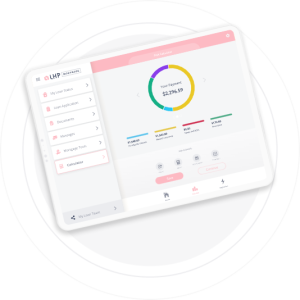
Nuestra aplicación interactiva le guía a través de las diversas etapas del proceso de compra de una vivienda y de su financiamiento hipotecario. La aplicación ayuda a mantenerle a usted, a su asesor de préstamos y a su agente inmobiliario conectados y sincronizados entre sí. Nos permite a todos trabajar en conjunto para hacer que el proceso sea fluido y sencillo.
La hago simple
Nuestra aplicación interactiva le guía a través de las diversas etapas del proceso de compra de una vivienda y de su financiamiento hipotecario. La aplicación ayuda a mantenerle a usted, a su asesor de préstamos y a su agente inmobiliario conectados y sincronizados entre sí. Nos permite a todos trabajar en conjunto para hacer que el proceso sea fluido y sencillo.